Walk down any commercial street after sunset and you are surrounded by them: LED display screens selling phones, football ribbons flashing replays, airport boards announcing gates. Behind every one of those panels sits a single decision that quietly determines whether the image looks vivid or washed out — the RGB diode chosen for each pixel. In 2026, one package keeps appearing on the specification sheets of buyers who care about that decision: the 2727 RGB SMD LED.
A 2.8 x 2.7 mm Package With Three Colours Inside
The 2727 is a PLCC6 full-color diode measuring just 2.8 x 2.7 x 2.45 mm. Three independent chips — red at 620–635 nm, green at 520–530 nm and blue at 465–475 nm — share one compact body, each drawing 20 mA at 1.8–2.4 V (red) or 2.8–3.4 V (green/blue). Luminous intensity is binned at 160 mcd, 550 mcd and 140 mcd respectively, giving pixel designers a predictable base for white balance without heavy driver correction.
What separates a good 2727 from a cheap one is rarely the datasheet headline. It is the details: San'an or Epistar chip material, 99.99% gold wire bonding, efficient heat dissipation through the package base, and strong anti-static performance that keeps failure rates low on fast SMT lines. Those are the properties that decide whether a screen still looks uniform after 20,000 hours of summer heat.
Three Application Scenarios Where This Diode Earns Its Keep
1. Outdoor advertising LED display screens. Billboard and street-facing screens are judged from 10–50 metres away in direct sunlight. The 2727's intensity headroom and high contrast housing keep brand colours saturated at high brightness, while the 60,000-hour lifetime keeps maintenance crews off the scaffolding.
2. Stadium and arena perimeter ribbons. Sports displays run continuously under floodlights, and they must switch frames without ghosting. A well-binned 2727 with consistent wavelength spread lets the control system hit high refresh rates with clean, ghost-free motion — exactly what broadcast cameras demand.
3. Indoor fine-pitch signage in transport hubs. Airport, metro and mall screens combine tight pixel pitch with long daily duty cycles. The 2727's small footprint supports dense layouts, and its stable colour over the −40°C to 85°C operating range keeps signage readable whether it hangs above a departure gate or beside a cold-chain loading dock.
Key Specifications at a Glance
| Parameter |
Value |
| Model | 2727 RGB SMD LED (PLCC6) |
| Package size | 2.8 x 2.7 x 2.45 mm |
| Wavelength | 620–635 / 520–530 / 465–475 nm |
| Luminous intensity | 160 / 550 / 140 mcd |
| Forward current / voltage | 20 mA; 1.8–2.4 V red, 2.8–3.4 V green & blue |
| Power dissipation | 60 mW |
| Chip brand | San'an / Epistar |
| Lifetime / warranty | 60,000 hours / 3 years |
| Operating temperature | −40°C to 85°C |
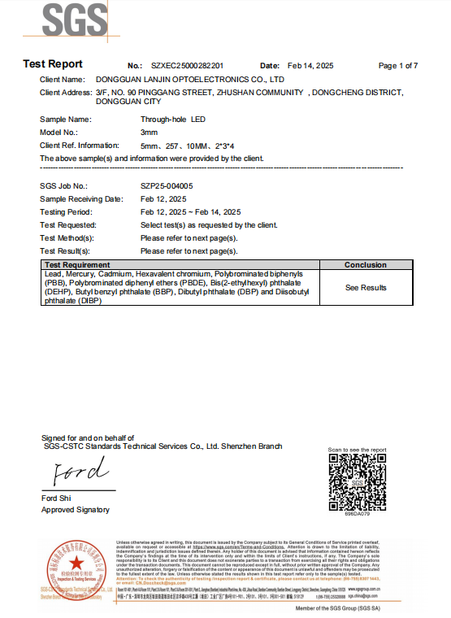
| Compliance | RoHS, Reach |
Four Design Notes for Display Manufacturers
- Bin before you build. Request intensity and wavelength bins per reel; mixed bins are the number one cause of "patchy white" complaints on installed screens.
- Drive below the ceiling. Running at 20 mA nominal with short duty cycles protects junction temperature and preserves colour shift margins in hot cabinets.
- Treat the housing as an optical part. Contrast depends as much on the package face as on the chip — verify the black-face option matches your panel louvre design.
- Validate ESD handling. Anti-static capability only helps if your SMT line grounding, ionisers and reel storage are in order.
Where These Diodes Come From
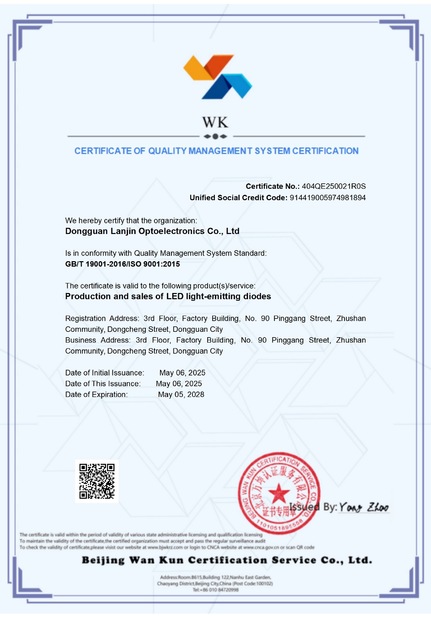
Behind the specification is a manufacturer most European and North American display integrators already know: Dongguan Lanjin Optoelectronics Co., Ltd. (蓝晋光电). Established in 2005 and exporting 80–90% of its output, Lanjin has spent two decades doing one thing — SMD LED diodes, from top-view and side-view chips to RGB, IR, UV and high-power packages — with a supply ability of 500KK per month and full customisation on wavelength, intensity and lens options.
For the 2727 RGB SMD LED that means practical terms: 2,000-piece minimum order, 2,500 pieces per reel packed in anti-static bags and cartons, 5–15 day delivery, and T/T, Western Union or PayPal settlement. Samples are available for evaluation, and the engineering team can quote alternative bins for projects with tight colour tolerances.
Every screen is a promise: the colour on the panel should match the colour the brand approved. Choosing the right diode is how that promise gets kept, hour after hour, in sun and rain. Explore the full RGB and display LED range at www.lanjinlight.com, or send your pixel pitch and brightness target and let Lanjin's engineers match the bin for you.


 Your message must be between 20-3,000 characters!
 English