As public health awareness continues to rise, sterilization and disinfection have expanded well beyond hospitals and laboratories into smart homes, public spaces, water treatment, personal care, and virtually every corner of daily life. At the heart of this disinfection technology upgrade lies the 3535-packaged deep-ultraviolet UVC LED — compact, efficient, mercury-free, and rapidly replacing conventional mercury lamps as the "light engine" of next-generation sterilization solutions.
1. Why the 3535 Package?
The 3535 package, measuring 3.5 mm * 3.5 mm, is currently one of the most mature and widely adopted mid-power form factors in the UV LED industry. Compared to smaller formats like 2835 or larger ones such as 5050/6868, the 3535 strikes an optimal balance across three key dimensions:
- Superior Thermal Management: The aluminum nitride (AlN) ceramic substrate offers excellent thermal conductivity, keeping junction temperatures under control during high-power-density operation — a critical factor that directly determines LED lifespan and lumen maintenance.
- Favorable Optical Matching: With 60° to 120° quartz glass lenses, 3535 LEDs allow straightforward secondary optical design and seamless integration into various sterilization modules.
- High Volume-Manufacturing Consistency: Mature die-bonding, wire-bonding, and eutectic processes ensure tight wavelength consistency (typically within ±2.5 nm) in mass production, which is essential for reliable and repeatable disinfection performance.
2. Core Application Scenarios
2.1 Flowing-Water and Static-Water Disinfection
3535 UVC LEDs can be integrated into flow-through sterilization modules at the terminal end of water purifiers, drinking fountains, and direct-drinking faucets. UVC light in the 265–280 nm band irradiates flowing water, achieving inactivation rates above 99.9% within seconds — without introducing chemical by-products or altering water taste. For static-water scenarios such as portable outdoor purification bottles, coffee machine reservoirs, and humidifier tanks, 3535 LEDs offer a miniaturized, low-power disinfection solution.
2.2 Air Disinfection and HVAC Systems
In central air-conditioning ducts, air purifiers, elevator cabins, and hospital wards, 3535 UVC LED arrays are embedded into return-air vents or standalone disinfection modules to continuously inactivate airborne bacteria and viruses. Unlike conventional mercury lamps, LED-based solutions require no warm-up time — they deliver instant, on-demand disinfection — and pose zero risk of mercury vapor leakage should breakage occur.
2.3 Surface Sterilization and Consumer Electronics
Phone sanitizers, toothbrush sterilizers, beauty-tool disinfection cases, and baby-bottle sterilizers represent the fastest-growing application segment for 3535 UVC LEDs in recent years. These consumer products demand compact form factors, low power consumption, and high safety — all perfectly matched by the 3535 package. Beyond personal devices, 3535 UVC LEDs are also gaining rapid adoption in public-facility surface sterilization, including supermarket checkout counters, parcel locker interiors, and smart toilet seats.
2.4 Medical and Laboratory Equipment
In PCR laboratories, biosafety cabinets, and medical endoscope reprocessors, 3535 UVC LEDs provide precise, localized disinfection for critical components. Their purely physical sterilization mechanism generates no ozone, making them especially suitable for precision instruments that are sensitive to chemical residues.
2.5 Refrigerators and Food Preservation
Select high-end refrigerators now incorporate 3535 UVC LED sterilization modules inside the fresh-food compartment, using intermittent irradiation to suppress mold and bacterial growth on fruit and vegetable surfaces, extend shelf life, and eliminate odors.
3. Key Technical Selection Criteria
| Parameter |
Recommended Specification |
| Peak Wavelength |
265–280 nm (optimal germicidal efficiency range) |
| Optical Output Power |
≥ 10 mW @ 100 mA; ≥ 30 mW @ 350 mA |
| Package Material |
AlN ceramic substrate + quartz glass lens |
| Thermal Resistance |
≤ 10 °C/W |
| Lifetime |
L70 ≥ 10,000 hours |
| Wavelength Consistency |
Within ±2.5 nm |
4. A Reliable Choice in the Supply Chain
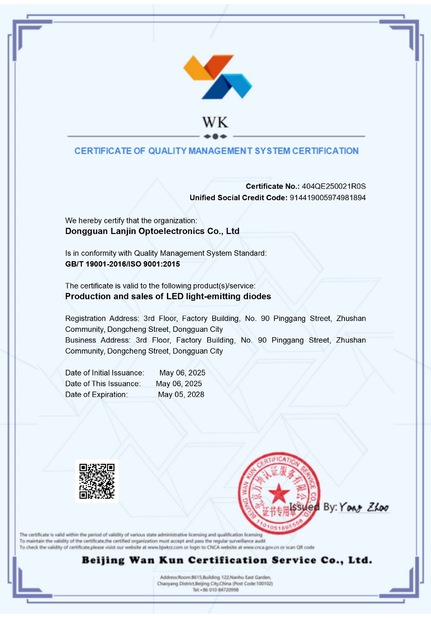
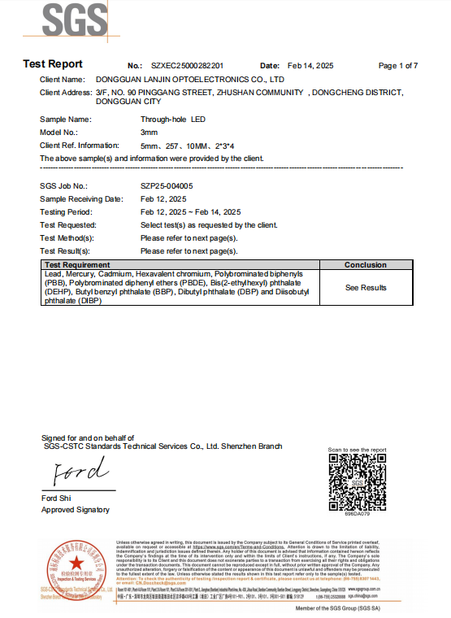
Within China's UVC LED packaging sector, Dongguan LanJin Optoelectronics Co., Ltd. has accumulated deep expertise in LED packaging over many years, with a product portfolio spanning the full UVA/UVC spectrum. The company's 3535 deep-ultraviolet series utilizes high-purity AlN ceramic substrates and eutectic die-bonding technology, delivering stable performance in optical output power, wavelength accuracy, and batch-to-batch consistency. LanJin Optoelectronics already supplies core light sources to multiple brands in the water purification, air disinfection, and consumer electronics sectors. For manufacturers developing sterilization products, LanJin provides comprehensive technical support — from LED selection and optical matching to thermal management design.
5. Future Outlook
With the Minamata Convention imposing increasingly stringent global restrictions on mercury-containing products, the transition from conventional mercury lamps to UVC LEDs is now an irreversible trend. At the same time, 3535-packaged LEDs are seeing steadily rising optical output power and continuously declining unit costs, accelerating penetration into mass-market applications. Over the next three years, emerging scenarios — in-vehicle sterilization, wearable disinfection devices, and logistics parcel sanitization — are poised to become the next breakout opportunities for 3535 UVC LEDs.
Conclusion: From water purification to air treatment, from medical instruments to everyday consumer products, 3535 UVC LEDs are quietly shaping a safer, microbe-controlled world — one invisible beam of light at a time. For forward-looking brands and solution providers, now is the golden window to enter the deep-ultraviolet sterilization arena. And choosing a technically robust, mass-production-proven light-source partner will be the critical first step.


 Your message must be between 20-3,000 characters!
 English