Far-red light is the quiet variable that decides whether a crop finishes strong or finishes flat. Most indoor growers already run white, deep-red and blue channels. The band that still gets left out of the recipe is 730–740 nm — and that is exactly the band this month’s featured model was built for.
Why 730–740 nm Deserves a Channel of Its Own
Chlorophyll absorbs red and blue light, but plant strategy is driven by phytochrome: the red-to-far-red ratio tells a plant whether it stands in open sun or under a canopy. Add far-red and it reads “room to grow”; remove it and it reads “shaded, stretch fast”.
That single photobiological lever shows up in commercial results growers care about:
- Internode stretch control — tighter, more saleable transplants and potted ornamentals.
- Faster flowering onset — crops respond to end-of-day far-red pulses.
- Higher fresh weight — the Emerson enhancement effect lifts quantum yield when far-red is paired with red.
- Better rooting and uniformity — especially in propagation and tissue culture rooms.
Meet the Featured Model: 2835 SMD LED 730 nm / 740 nm Far-Red
A 2.8 × 3.5 × 0.8 mm top-view 2835 package at 0.2 W, with a 730–740 nm peak aimed squarely at phytochrome Pfr conversion. It shares pads, reel pitch and reflow profile with mainstream 2835 white and deep-red parts, so a far-red channel can be added to an existing board without a redesign.
| Parameter |
Value |
Why It Matters |
| Package / Size |
2835 SMD, 2.8 × 3.5 × 0.8 mm |
Drop-in footprint for existing grow boards |
| Peak Wavelength |
730–740 nm far-red |
Targets phytochrome Pfr, the stretch and flowering switch |
| Power / Current |
0.2 W, 60 mA |
Low thermal load in dense arrays |
| Forward Voltage |
1.8–2.2 V |
Runs on standard low-voltage channels |
| Radiant Output |
0.5–0.8 lm (radiant band) |
Judge it by photons, not lumens |
| Viewing Angle |
120° |
Even mixing in multi-channel fixtures |
| Lifetime / Warranty |
50,000 h / 3 years |
Matches the service life of the fixture |
| Thermal Range |
−40 °C to +85 °C |
Greenhouse roof to cold storage room |
| Chip Source |
San’an / Epistar |
Stable wavelength binning, batch to batch |
| Packing / MOQ |
4,000 pcs/reel, MOQ 4,000 pcs |
Pilot runs without a container commitment |
Five Application Scenarios Where This Chip Earns Its Place
1. Winter Greenhouse Supplemental Lighting
Northern-latitude greenhouses lose intensity and far-red share from November to February. A 730–740 nm channel added to existing HPS or LED top light restores R:FR balance, tightens tomato and pepper transplants, and shortens the cycle by days.
2. Vertical Farms and Leafy Greens
Multi-tier racks are photon-limited, not sun-limited. Far-red at roughly 5–15% of total photon flux in lettuce and basil recipes raises fresh weight per kWh and keeps heads compact for retail packs.
3. Photoperiod and Flowering Control
End-of-day far-red pulses let growers shorten the dark period without triggering premature flowering in short-day crops, and push long-day ornamentals into flower on schedule. The pulse lasts seconds, so electrical cost is negligible.
4. Propagation, Tissue Culture and Research
In cloning rooms and growth chambers, far-red reduces apical dominance and improves rooting uniformity, while the 2835 footprint makes spectrally tunable research panels easy to build.
5. Retrofit of Existing White + Deep-Red Fixtures
Fixtures already running 660 nm deep-red and 450 nm blue have unused board space. Swapping one deep-red row for far-red, or adding a dedicated channel, upgrades the spectrum without changing driver topology, since Vf of 1.8–2.2 V fits the same constant-current window.
Design Notes for Fixture Engineers
| Design Point |
Recommendation |
| Channel share |
Start at 5–15% of total photon flux, then tune per crop |
| Mixing distance |
Interleave far-red with white/deep-red rows; keep 120° beams overlapping |
| Thermal design |
Standard 2835 aluminium MCPCB, low junction temperature protects wavelength bin |
| Measurement |
Specify with a spectroradiometer (PPFD per channel), never with lumens alone |
| Eye safety |
Far-red is invisible; add warnings and interlock covers on open arrays |
Supply, Consistency and a Name Buyers Already Know
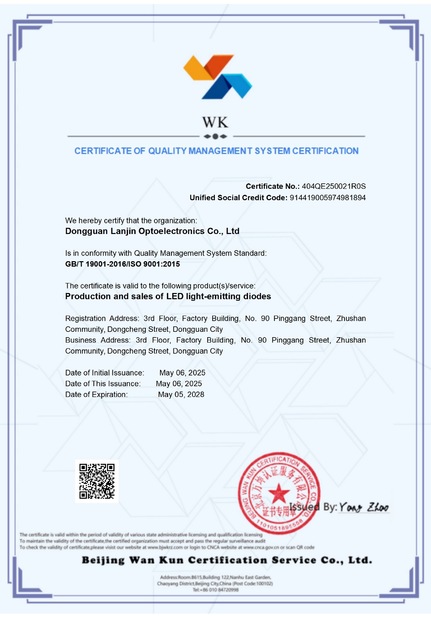
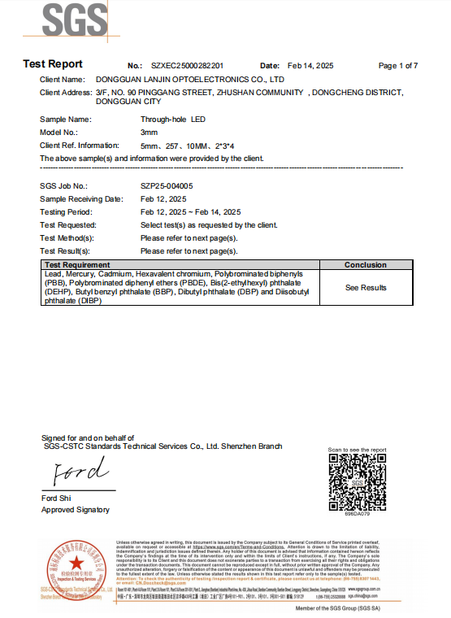
Behind the part is Dongguan Lanjin Optoelectronics Co., Ltd. (东莞市蓝晋光电有限公司), a BOSMFC-branded LED manufacturer established in 2005, exporting 80–90% of output to lighting and horticulture customers worldwide. For grow-light projects that means consistent wavelength binning, RoHS and Reach documentation, 500KK/month capacity, 5–15 day lead times, and a three-year warranty carried on the reel label rather than buried in a footnote.
Whether you build a full horticulture fixture line or source led lights parts for one propagation room, start with a sample reel and a side-by-side spectral test.
Takeaway: 730–740 nm far-red is no longer a laboratory detail. With a 2835 footprint, 0.2 W drive, 50,000-hour life and a three-year warranty, this chip upgrades spectrum quality without touching board design — the cheapest yield gain left on the table.


 Your message must be between 20-3,000 characters!
 English